Interview with Elisa Bernard
“The 128KB constraint challenges the default narrative of digital creation”
October 6, 2026
We’re starting a new series of conversations with a selection of creators behind the GIFs.
We’ll explore their work, their process, and the limits they push against. The same questions, different approaches. A look inside the ideas and experiments that take shape within 128KB.
First up: Elisa Bernard.
Elisa is a graphic and interactive designer specialized in print, passionate about mixing digital and physical media. She loves crossing boundaries between artifacts—exploring where typography, visual identity, and creative coding intersect. Based between Paris and Geneva, she works on branding, editorial design, and interactive experiences. Print-trained and drawn to edges, she´s focused on creating visuals that stick and challenge the limits of each medium.
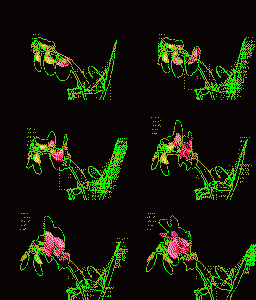
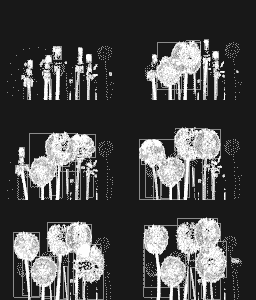
Did you have any inspiration before creating your GIFs? If so, what was it?
Yes! I was based in Geneva at the time, and it was spring—everything was blooming. I was inspired by the physical world of plants and that sense of organic growth. I wanted to translate that into the digital realm, bringing the physicality of nature into pixels. The project, When Pixels Bloom / I_Dream_In_Pixels_Petals, draws from Aristid Lindenmayer’s work on the algorithmic beauty of plants—his mathematical models that describe how plants grow in real life. By extending these generative principles into the digital space, I asked myself: can pixels bloom? The idea was to make plants grow on screen, capturing that living, moving quality of spring in a digital format. It’s about blending pixels as a universal digital language with natural forms—creating a conversation between the natural world and code, exploring how machines interpret life and how nature might help us understand the logic of machines.
Did you learn something new during the process? If so, what?
Yes, significantly. I explored blob detection techniques often used in TouchDesigner, but wanted to understand how similar effects could be achieved in Processing using the BlobDetection library. This led me to experiment with different approaches—thresholding, edge detection, and Laplacian of Gaussian—each revealing new possibilities for how forms emerge from pixels. I also discovered the potential of dithering and tiling techniques not just as optimization methods, but as aesthetic tools. Reducing file size through dithering revealed an unexpected beauty in these constraints. On the technical side, working with command-line tools like gifsicle for GIF optimization and manipulation opened up new workflows, and I used Mistral AI to assist with debugging throughout the process.
What was the most interesting thing for you about creating within the proposed limits?
The 128KB constraint was fascinating precisely because it challenges the default narrative of digital creation. We’re often taught that digital art demands heavy software, powerful machines, and unlimited file sizes—TouchDesigner, Blender, endless rendering. But working within such a small format inverted that paradigm. The limitation became a creative playground, forcing me to think differently: how do you create compelling visuals with minimal bytes? How do you reduce digital footprint without sacrificing intent? This constraint raises fundamental questions about digital creation itself. It questions our assumptions about computational power and file size as measures of complexity or quality. Working with less—fewer colors, optimized code, dithering as both aesthetic and technical strategy—revealed that restriction can be a generative force, pushing toward more intentional and elegant solutions.
More by Elisa Bernard .