Interview with Peter Ha
"Working within constraints can sharpen focus and spark interesting ideas"
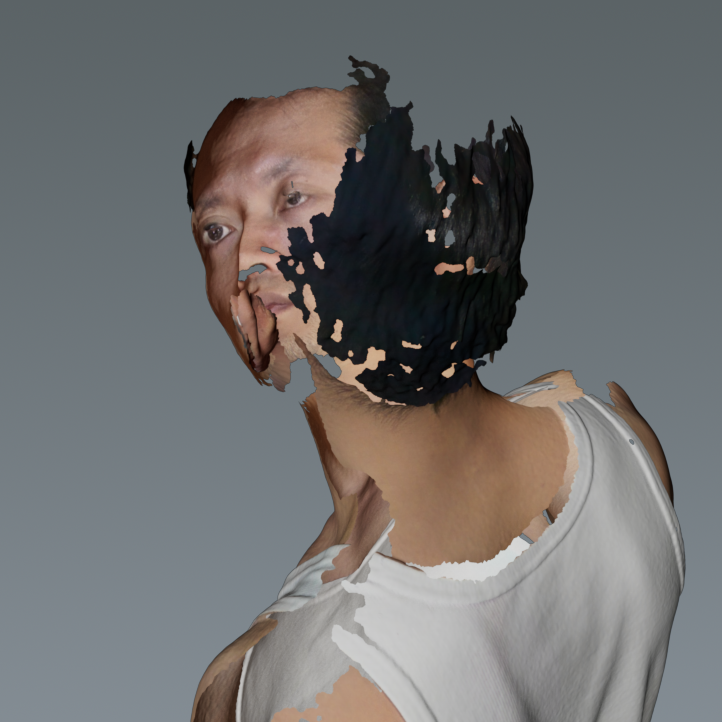
Hi! Welcome to a new installment of our interviews with the creators of 128KB. This week, we spoke with Peter Ha, a graphic designer and creative programmer based in Toronto.


Peter Ha is a designer, artist and educator. He is a co-founder of Equal Parts Studio, a Canadian-based contemporary graphic design practice whose process is founded on curiosity and finding the joy and playfulness in every project. His professional experience as a visual communicator informs his code-based art, using shapes, colour, and movement to create bold and mesmerizing visuals. Alongside his studio work, he’s shared his expertise by teaching graphic design at OCAD University and Toronto Metropolitan University. He’s recently graduated from the Master's in Media Design at HEAD–Genève; it was during his time in this program that he discovered the “128kb” project :)
Did you have any inspiration before creating your GIFs? If so, what was it?
My inspiration came directly from the 128kb website, my fascination with typography and how we’re constantly bombarded by messages. At the time, there was a data counter on the site and as you scrolled, it tallied the total file size consumed. I thought this was an interesting feature because it exposed our data consumption on a website, which is often forgotten or ignored. I wondered whether it would be possible to create a moving font where the total file size was under 128kb. I then linked this to a typing interaction where each letter is a GIF, and you are limited to a message under 128kb.
Typography is a pervasive medium and perhaps the most accessible one. We all have access to fonts on our computers. Font technology has progressed from bitmap images used to render letters to variable colour fonts that fine-tune parameters. However, the advancement has left out motion. Lastly, we’re always reading some form of text on our screens from emails, text messages, captions, this blog post. The motion of the GIFs captures someone’s attention, but it also plays on the fleeting messages we encounter in our daily lives.
Did you learn something new during the process? If so, what?
For this project, I was trying to draw and erase letters quickly and using a mouse or trackpad didn’t cut it. So I needed a tablet and stylus to mirror drawing letters by hand and from this, I learned that you can access the pen pressure as a variable. While I didn’t incorporate the pen pressure in the final design—because I really did have to keep the lettering quite simple—I was made aware and maybe in the future I’ll explore this feature for illustration in Processing.
In addition, Tim shared a reading, “Permacomputing Aesthetics: Potential and Limits of Constraints in Computational Art, Design and Culture”, which introduced me to concepts about the connection between technology and aesthetics. It made me reflect on my own practice and process and how, in pursuing something aesthetically pleasing to me, I can also contribute to waste.
I came up with the idea and concept for the GIFs quite early in the process, but I still explored it. Through exploration, many individual image files sit on my computer before they become a GIF; they are stored on my hard drive and uploaded to the cloud, adding another layer of digital processing waste. It’s also true for my other creative coding works where I have many, many, many outputs that never see the light of day because part of a generative process, at least for me, is to see what surprises or outcomes can come from the system you created—and this means you would need to run the program multiple times before you are satisfied.
What was the most interesting thing for you about creating within the proposed limits?
I really tried to make the font as interesting as possible within the constraints. Of course, one way is through form, and the other is through movement to take advantage of the GIF format. At some point, I kind of had fun optimizing each letter to fit within the constraint—it kind of became a game for me. It was also a nice reminder that working within constraints doesn’t have to hinder the creative process. Instead, it can sharpen focus and spark interesting ideas.
More by Peter Ha .